


Just about everyone in the housing policy space is familiar with the Auckland story. In 2016, New Zealand’s largest city upzoned about three-quarters of its residential land. Construction surged—over the next seven years, roughly 112,000 new homes were built, in a city that started with about 530,000. Rents for three-bedroom homes ended up being 22 to 35 per cent lower than they would have otherwise been.
Auckland is by some distance the cleanest natural experiment in the modern housing debate, and the evidence that it worked—that relaxing planning restrictions led to more homes being built—is about as settled as anything in the field of urban economics.
So settled is the debate that everyone now wants to claim the victory as their own. Success has many fathers, and Auckland’s paternity queue stretches round the block. And yes, reform is messy. Policy development is often an exercise in choruses and canons—ideas are picked up, put down, left in a drawer, rearranged. By the time a change is finally made, it can be very difficult for any individual person or organisation to take direct credit for anything.
This, by the way, is fine. You work toward positive change for the sake of positive change, not for the sake of getting the credit.
With that in mind, I wanted to work out what actually happened in Auckland. And so I sat down a few months ago to record a live episode of the Inflection Points Podcast at the ANU. This episode, expanding on an essay we published—How to Model a Housing Market—is what sent me down the path of trying to establish the timeline of how the world’s most famous upzoning actually came to be.
I owe a great deal of credit to Eleanor West’s excellent thesis, and her article with Marko Garlick for Works in Progress, as well as the input of various folks from Greater Auckland. Between all of these, I was able to put together as good a timeline as I could laying out how the upzoning actually happened.
How Auckland’s upzoning happened
2010
New Zealand’s central government forcibly merged eight councils into one Auckland Council and ordered it to produce a single Unitary Plan (the AUP). The amalgamation was not driven by housing, but by a perceived need to coordinate transport access and infrastructure across New Zealand’s largest city. It was mobility that drove Auckland’s amalgamation first and foremost, and all the successes of Auckland’s housing policy sits downstream of an amalgamation oriented toward making the city more cohesive, connected, and accessible.
March 2013
Three years after amalgamation, Auckland Council released their Draft Unitary Plan for consultation. It proposed significant, broad upzoning. The Draft Plan proposed a zoned capacity of around 310,000–470,000 dwellings, a 60–120k uplift over and above the 250,000–350,000 that existed under the previous eight individual councils’ plans.
September 2013
Six months later, the Proposed Unitary Plan landed, and an estimated 50,000 dwellings of capacity has been stripped out. This capacity had largely been removed from Auckland’s more central, wealthier suburbs, where a proposed three-storey zoning was taken back down to two. This is a typical outcome of ‘strategic’ planning processes: consultation often results in wealthier areas getting let off the hook for growth—leading to a decidedly non-strategic mismatch between density and amenity.
That said, the Plan was still an increase over the status quo, but its impact was set to be far more modest: a large proportion of the homes on paper would not actually be feasible to build. This is because so much of the new theoretical capacity had been removed from high-amenity areas, and instead placed further from the city centre, in places where denser housing just wouldn’t stack up.
2013–2016
Following this, the Proposed Unitary Plan then got sent over for consideration by the Independent Hearings Panel (the Panel), appointed by New Zealand’s central government. This involved a large amount of back-and-forth between Council and government bodies, between experts and community members, all of which cannot be detailed here. One key moment of note, however, was when Auckland Council submitted to the Panel—apropos of nothing—that they’d actually like to do even less upzoning. This is what’s called an unforced error.
New Zealand’s central government made it extremely clear to Auckland Council that they would intervene if the Council did not accept the changes the Panel recommended. The central government had previously proven this was not a bluff, when they redrew the Christchurch area’s zoning following the 2014 earthquake, with zero Council involvement.
The centre-left opposition Labour Party’s housing spokesperson, Phil Twyford—the eventual architect of many subsequent nation-wide planning reforms—had also by this point co-written an op-ed with a prominent centre-right think tank, The New Zealand Initiative. This made it clear that the support for reform was bipartisan. This ensured that Auckland Council could not simply hold out until a change of government that they hoped might let them off the hook.
July 2016
After almost three years of discussion, the Panel reported back in July of 2016, unimpressed with Auckland Council’s Proposed Plan—let alone their mid-Panel submission to do even less.
The Panel weighed the evidence presented throughout the process, and recommended that Auckland Council implement dramatically more upzoning than their Proposed Plan. Recommendations from the Independent Hearings Panel included:
Cutting the restrictive Single House zone by 22 per cent,
Expanding the three-storey Mixed Housing Urban zone by 48 per cent, and
Dismissing the Council’s proposed blanket ban on demolishing anything built before 1944, on the grounds that there was “an insufficient basis to restrict the demolition of buildings based solely on their age”.
These recommendations were then sent back to the Council for implementation.
August–November 2016
Three months later, with remarkable speed, Auckland Council adopted the Panel’s version of the Unitary Plan. It became operative in November 2016, at which time the city’s feasible capacity was almost doubled compared with the Proposed Plan that the Auckland Council had put forward—increasing from around 213,000 homes to 422,000 homes.
And then the rest, as they say, is history.
What Auckland tells us about Strategic Planning
In June, a Planning Institute of Australia policy executive wrote a column in The Fifth Estate titled “Auckland isn’t a simple story of blanket upzoning”. Its thesis: that Auckland’s success was actually a triumph of the strategic planning process.
According to the author, because around a quarter of residential land was deliberately kept low-density “due to heritage, environmental values, topography, natural hazards, or other important planning reasons”, we are supposed to believe that Auckland is a story about “metropolitan-scale strategic planning”.
This is not the case. The reality is this: at almost every stage of the strategic planning process that was controlled by Auckland Council, the city’s feasible housing capacity shrank significantly.
Auckland’s upzoning was only broad and successful because of the active involvement of New Zealand’s central government. It was central government that appointed the Independent Hearings Panel, and that made it extremely clear that they were willing to overrule any Plan that failed to deliver large amounts of upzoning. If Auckland Council had their way, then the upzoning would have been half the size, and less than half as effective.
Insofar as the local ‘strategic’ planning process had an impact on Auckland upzoning, it was negative. The main remaining artifact of the Council’s work is that the wealthier central city was not upzoned. Upzoning as a result of the strategic process concentrated between 5 and 25 kilometres from the CBD. The inner five-kilometre ring—the most transit-rich, high-amenity, in-demand land in the entire country of New Zealand, was skipped.
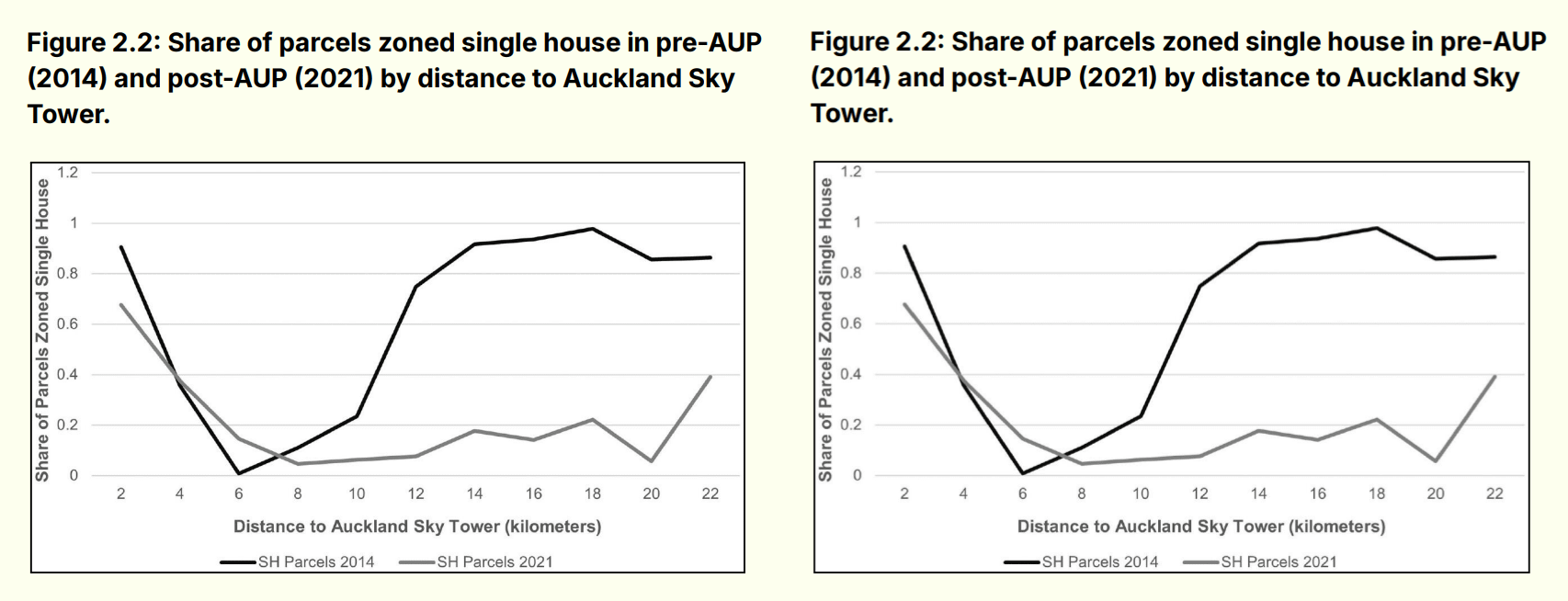
Eleanor West’s thesis records that many decision makers refer to the “low-density, high-socioeconomic suburbs” that was protected under this process as a “ring of shame”. It is a strike against both the local planning process and the central government Panel that these so-called character areas were not ultimately opened up to enable more people to live in the best, highest-amenity, and most accessible parts of Auckland.
Credit where it’s due
This is not to say that Auckland’s planning process achieved nothing good. Some of the upzoning was indeed strategic—in the sense that it upzoned locations with good access to public transport.
And this is true! But I don’t know how much strategic planning knowledge is required to understand that it’s a good idea to enable density around a train station. It does not take an expert to tell you that this seems like a solid policy.
Based on the discussions I’ve had with people who were inside the process, roughly half of Auckland’s upzoning can be traced to the strategic planning processes that fed into the Unitary Plan. The other half of the upzoning can be traced to central government, submitters, and general randomness. These are inexact estimates, of course—remember, reform is messy—but the point is that it’s quite a distance from the assertion that “Auckland’s success is a product of strategic planning”.
My favourite detail from the whole conversation is what happened immediately after the plan passed which was—nothing. Per the Inflection Points Podcast:
“Honestly, no one noticed. I think people forgot about it, actually... And about a year later, we started to see in the data around housing starts and consents a big uptick.”
That uptick kept going, and it surprised even the experts and the optimists. And so the research began, and the findings were substantial. They have informed the way the New Zealand government has gone about planning and land use reform ever since.
The actual lesson of Auckland
The Planning Institute of Australia’s Fifth Estate column closes by saying durable housing growth depends on strategic planning that gives everyone “confidence about where growth will occur”. But that is not really what happened in Auckland. In Auckland, confidence came from a central government that was willing to assert its support for growth whether or not the local gatekeepers approved. And when the Council’s plans failed to deliver enough capacity, an independent panel appointed by central government struck out the bulk of the planning restrictions that failed their test.
Planners have real things to be proud of in Auckland: the delivery of a single metropolitan plan, the transit-oriented geometry, the quiet professionals who wanted to do more and needed central government backup.
But planners cannot claim the outcome without acknowledging the realities of the process—the 50,000 homes that ‘strategic’ planning cut, the mid-hearing request from Council to do even less, the ring of shame, and the demolition ban that fell over the moment someone asked for evidence.
Auckland is not a story about unquestioningly trusting local strategic planning processes. Rather, it is a story about higher tiers of government’s legitimate strategic role in the planning process.
New Zealand’s central government shouldered many of the costs of Auckland’s longstanding housing shortage: unaffordability, low productivity, overcrowding, and costly subsidies to compensate for sky-high rents. Local governments typically bear very few of the costs that come along with restricting growth. It is for this reason that higher tiers of government—state and federal in Australia—are entitled to dictate the process and enforce a strategic bottom line: enabling sufficient development capacity to seriously tackle the housing shortage.
That’s what happened in Auckland, and the results speak for themselves.
The city continues to grow, because it was enabled to grow. And that’s a good thing, because a city is never finished. Neither, it turns out, is the fight over who gets to say they built it.