


In my teenage years, I became insufferable about film. I once forced my parents to watch Paul Thomas Anderson’s The Master, which is a fact they’ve never let me live down. To this day, any film recommendation I make to my father is met with: But is it as good as The Master? To which the answer is usually: No, of course not.
But I make recommendations anyway, including for him to go see Marty Supreme, which was good enough that I saw it twice in the cinema. The hype around that film was astronomical, the marketing weird and interesting, the countdown to release ecstatic. Timothy Chalamet was on TV repeating Marty Supreme Christmas Day Marty Supreme Christmas Day Marty Supreme Christmas Day like a sacred mantra.
But in Australia, Marty Supreme Christmas Day did not exist. The film was not released here until almost a month later, on January 22nd. In their reporting, Variety wrote that the release “coincided nicely with the January long weekend”, as well as with the year’s Oscar nominations announcement, and that it ended up being A24’s best opening in the country to date.
Marty also opened with screenings on 70mm film in places like Melbourne’s Astor theatre. Historically, physical film scarcity was a real constraint on distribution. Every additional film reel costs thousands of dollars to print, and shipping them is complicated and expensive. In the early 2000s, physical duplication and distribution costs were estimated to account for 3.5% of a film’s total cost.
Australia is small, and so historically we wouldn’t get our own bespoke prints for anything other than the biggest films. Instead, reels would be shipped over second-hand from larger markets like America and the UK.
Each of these individual facts provides its own neat little just-so stories for the Marty Supreme delay. And because A24 does not comment on its release schedule, we have to come to our own conclusions.
The physical film story sounded good to me, but Marty also opened on the 22nd in Portugal, Brazil, and New Zealand—with no physical film screenings I could find. Notably, this simultaneous release also discounts the Australia Day long weekend theory.
So I turned to the data, and the Oscars story became the key contender. It turns out that late-year Best Picture nominees are often released in Australia within a month of Oscar nominations announcement date.
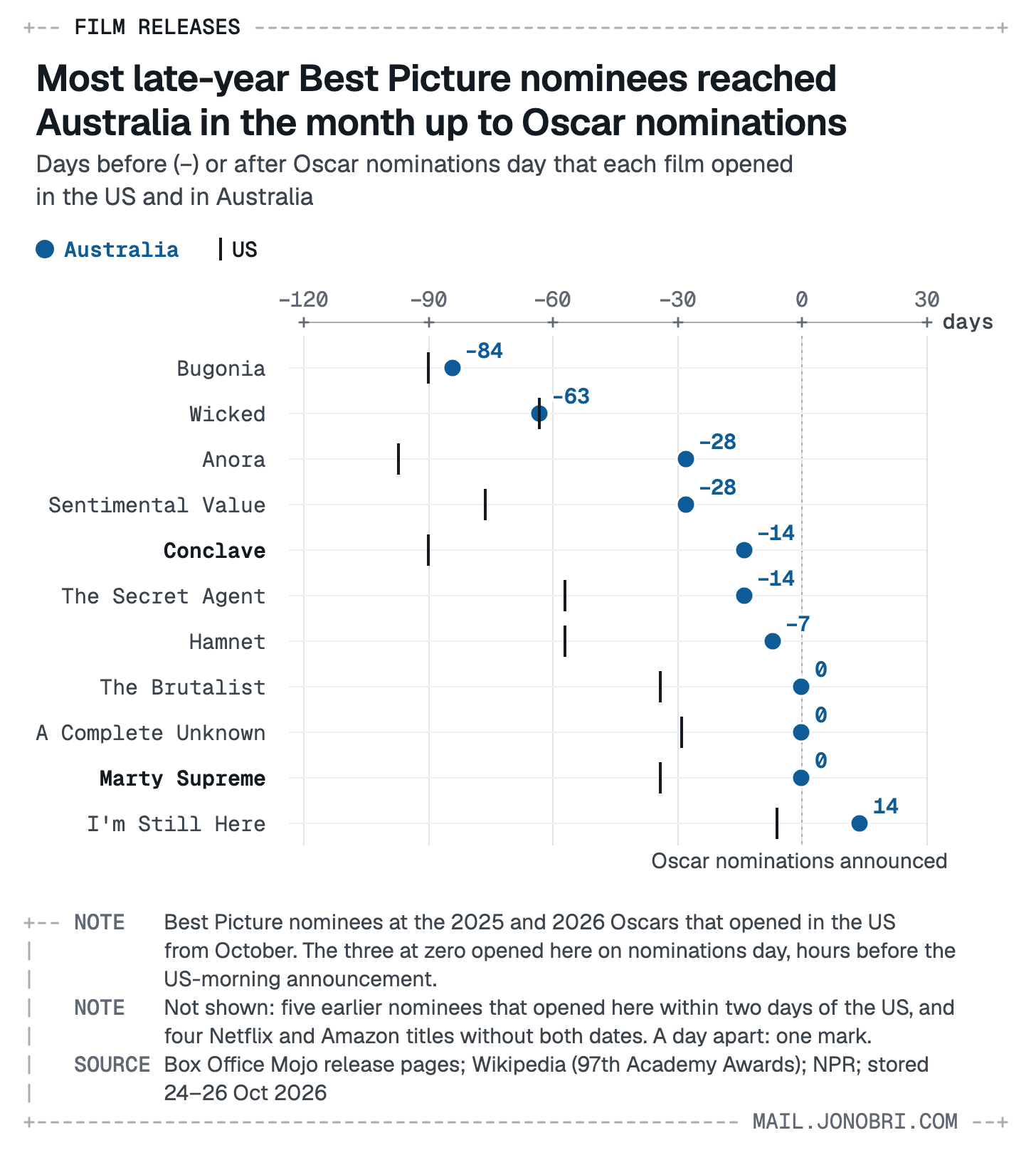
But most films aren’t late-year Oscar hopefuls, or shot and released on film, or released in the US within a month of Australia Day.
Most films are released throughout the year, with digital-only distribution. And most marketing is global: social media and digital ads are delivered frictionlessly to any person and any device. Cinema screens are scarce, yes, but Australia does not produce even remotely enough film to crowd out international competition. Plus, researchers have consistently estimated meaningfully lower returns for films that arrived late to foreign markets, a phenomenon which has worsened since the rise of easy piracy.
And yet despite all this, to this day, films continue to arrive late in Australia all the time. Why?
You can(’t) see everything
Right now, the most talked-about film in a certain corner of the world is You Can See Everything, the Elizabeth Holmes documentary created by Nathan Fielder and Lance Oppenheim. It’s out in the US as of October 16. But it’s not out in Australia until a month later—November 12—with no Oscars in sight.
This leaves us Australians dodging spoilers and discourse, missing out on memes, and feeling slightly disconnected from a cinemagoing culture that is, for better and for worse, increasingly globalised.
I want to see this film. Importantly, I want to have seen this film. So why can’t I?
First up, it’s worth noting that in the global scheme of things Australia is getting YCSE relatively early—tied fifth with New Zealand, and a week ahead of the UK.
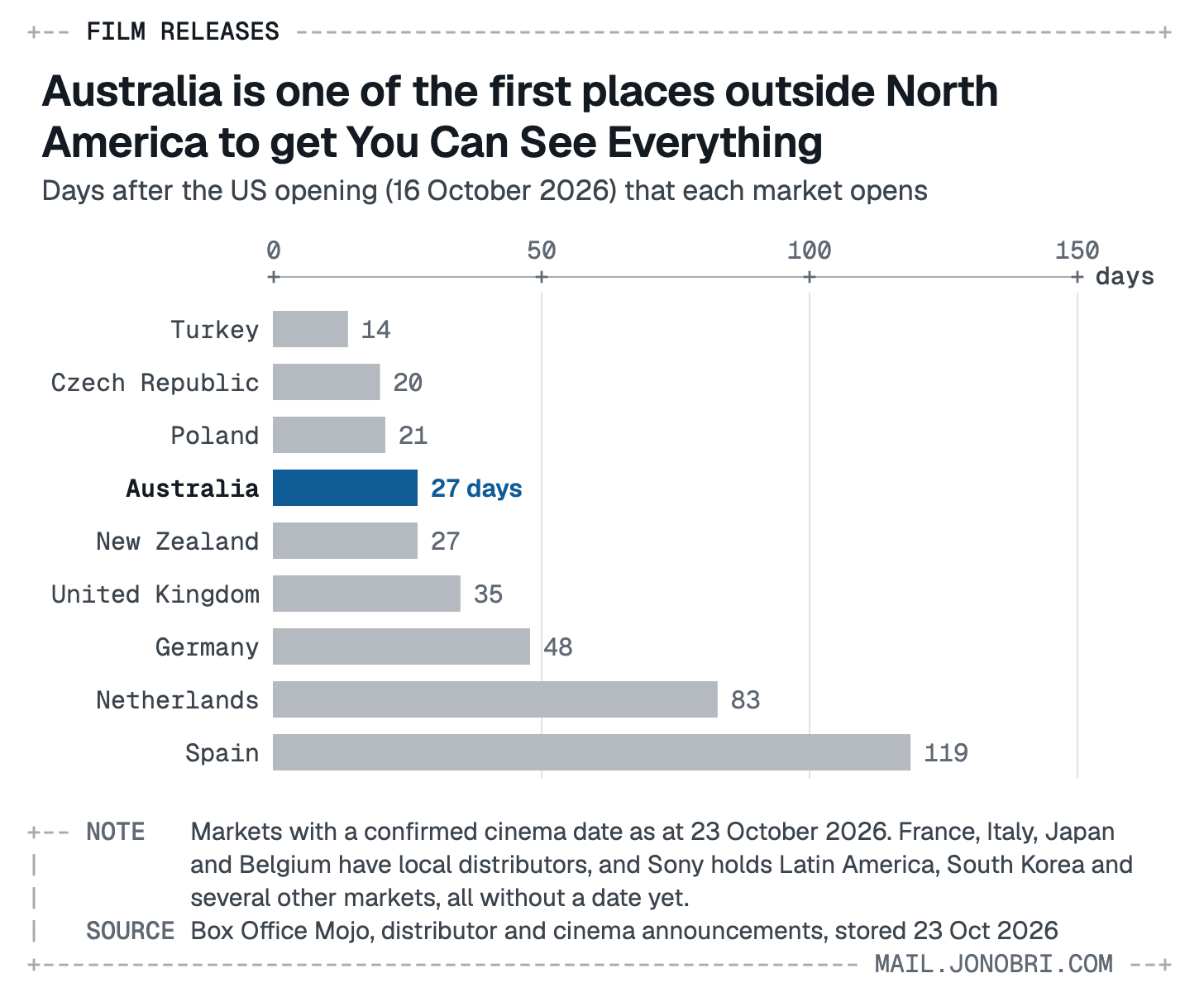
A24 is releasing the film itself, same as it did with Marty Supreme and Primetime, the latter of which is also set to be released this week after a delay. But it should be noted that delay is not a universal strategy for A24: Backrooms came out day and date in Australia and the US, even when other markets trailed. Warfare and Eternity were both released within about a week.
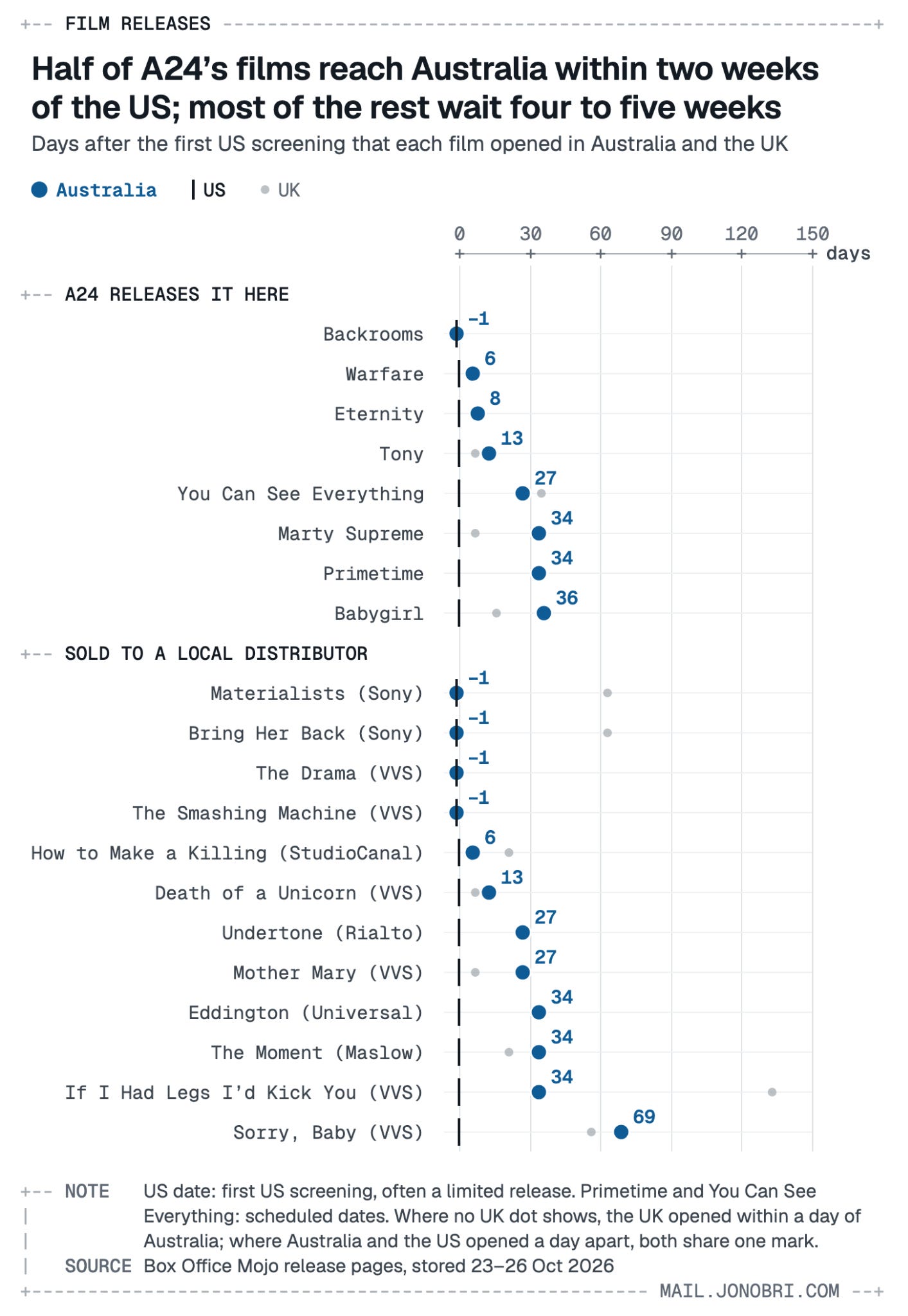
It’s also not like A24’s internal strategy is particularly unique. For films they distributed themselves in the US but not in Australia, the timelines look similar.
This is because even in a digital context, distributing a film is complicated. You have to talk to both chain and independent cinemas, you have to organise everything from posters to screen allocations. You will likely want to do some sort of local premier, maybe organise early screenings to build hype, and then make sure you’ve lined up local journalists and reviewers to cover the film ahead of time.
The announcement and release of YCSE was a complete and total surprise, which means that the resources to pull all this off were likely not able to be allocated ahead of time, even those close to the project were expecting such an off-beat film to become a phenomenon.
This example underscores a couple core drivers of delayed film releases:
Studios and distributors have limited resources.
No one knows how for sure how any given film will perform.
How to release a film
Larger films are produced by larger companies, and so they face fewer constraints. This is what allows studios like Universal and Warner to distribute films like The Odyssey and One Battle After Another across the entire globe simultaneously.
But most studios and distributors aren’t operating on the scale of Warner Brothers. Sticking with A24 here, Mona Tabbara wrote for the UK’s Screen Daily:
A24, which operates as a producer, sales agent and distributor, sells some films like a traditional agent [e.g. Pearl, Beau is Afraid, Past Lives] … [but] when it does not achieve the price it wants, A24 directly distributes its titles in the UK and Ireland.
Crucially, the fact that distribution rights are sold country by country introduces both uncertainty and competition to the equation. A24 has limited resources, but so does everyone else.
Let’s say you’re an Australian film distributor, and you reckon you can make money off of a small but star-studded drama like May December. The problem you face is that your team is quite small, and your schedule quite full. You want to distribute the film, but you have no capacity to do so until almost three months after the film’s North American release.
Still, you run the maths, taking into account any reduction in returns the delayed release might cause. You put in a bid, and you win. You suppose this tells you that however tight your team’s constraints, everyone else’s were tighter—that, or you’ve made a bad bet.
Either way, you now own the Australian rights to distribute May December, and that typically means you’re free to put it out on your own time. And so you go to the ratings board, start talking to cinemas, and—76 days after the US distributor—you finally put out the film.
In some cases a delay may not be a resourcing choice, but a strategy. Oscar hopefuls are often scheduled for Australian release in January or February, in part to capitalise on the buzz from any award nominations or wins, as Variety theorised about Marty Supreme. Australia’s school holidays and long weekends, which run on a different rhythm to the rest of the world, are also deliberate release targets.
But while strategies may exist, the reasoning for any given distributor’s release schedule is somewhat opaque. People online are pretty mad about A24’s global release patterns, and it’s hard to know what exactly led to You Can See Everything landing in only about a dozen countries worldwide.
What we do learn from Variety is this: in Australia, You Can See Everything has broken Palace Cinema’s single-day pre-sales record for its day-early screenings on November 11. I would have liked to have been there, but by then I’ll have hopefully already seen it: I land in the United States on November 7, and I plan to spend three of my most jetlagged hours at the cinema.
A taxonomy of Australian film releases
We can get a bit more systematic with our analysis here, by breaking down the top 100 Australian film releases of 2025, which lets us see which kinds of films are releasing when.
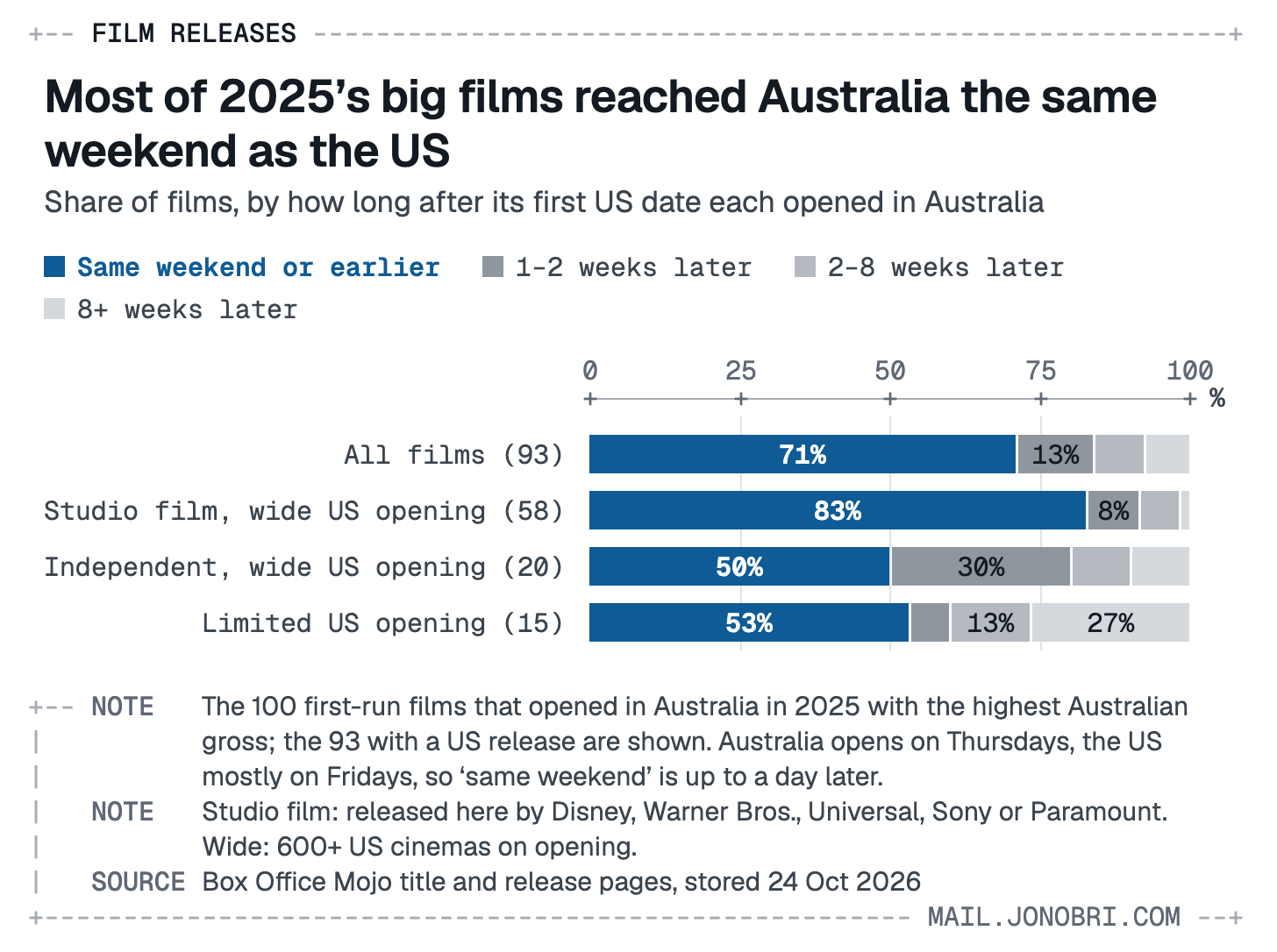
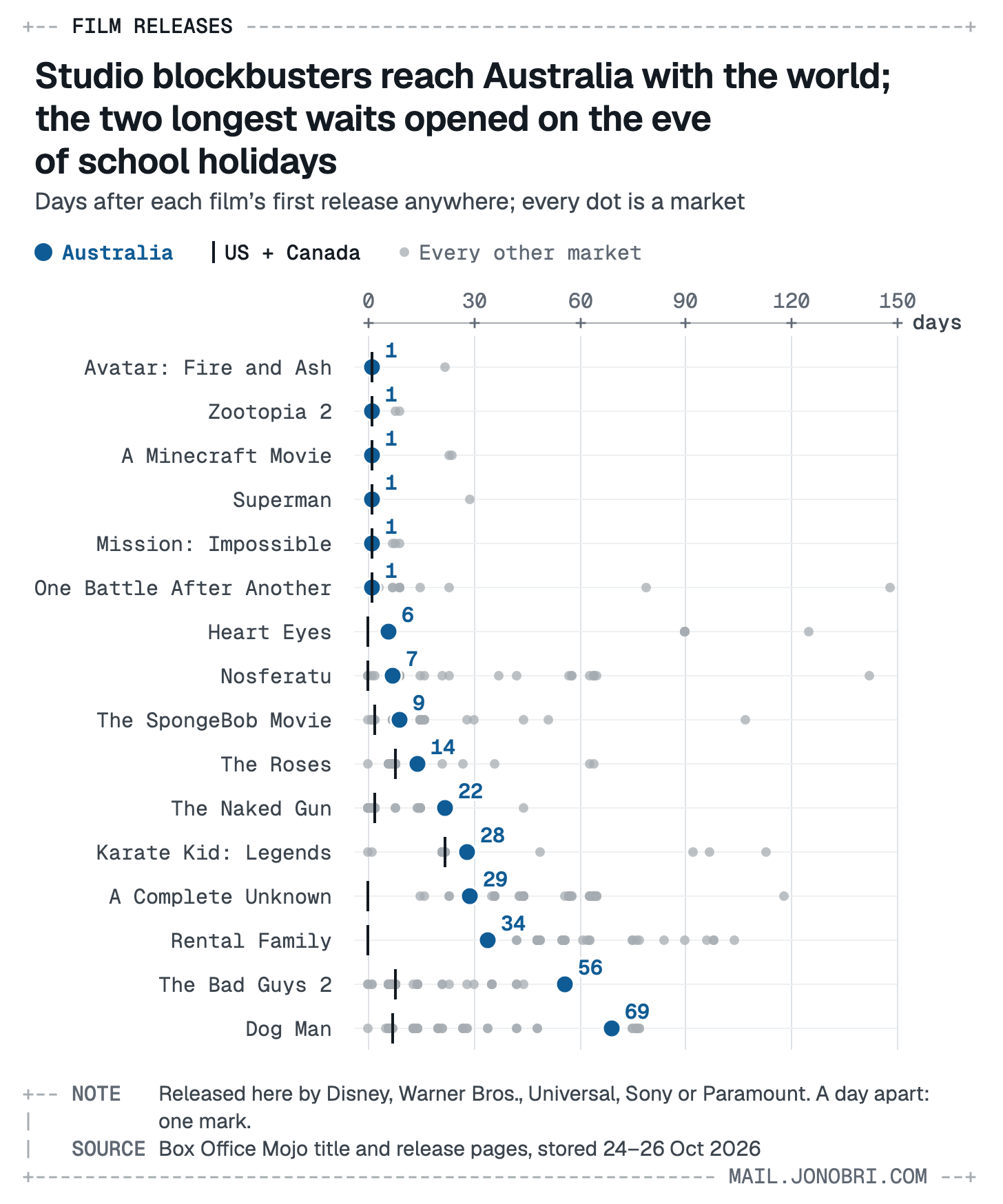
The first thing to note is that we do actually get most films at the same time as the US: more than two thirds of top films opened the same weekend.
Obviously, there are more than 100 films released a year, and a larger sample would see this proportion drop, because the 58 wide release studio films are currently raising the average. Interestingly, most of the 10 studio films that didn’t come out day and date appear to have been purposefully delayed to line up with Australian school holidays: films like A Complete Unknown, Rental Family, and Dog Man.
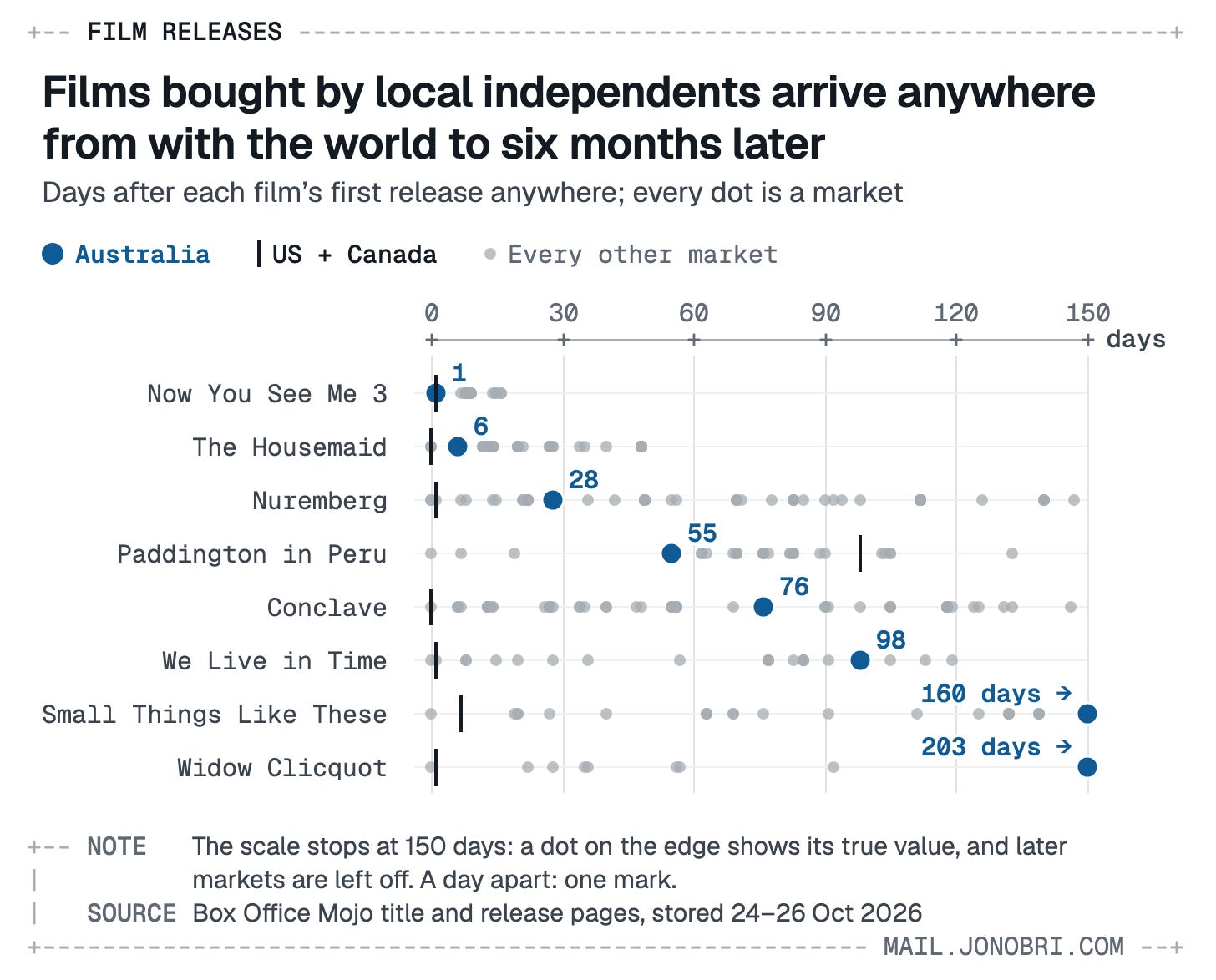
Of the 20 independent films that opened wide in the US, half opened here the same weekend or earlier, and another six within about a fortnight. We wait the longest for awards-hopeful titles that open in the US in the second half of the year and reach Australia between January and April. The long wait for Conclave and Small Things Like These tell this story nicely.
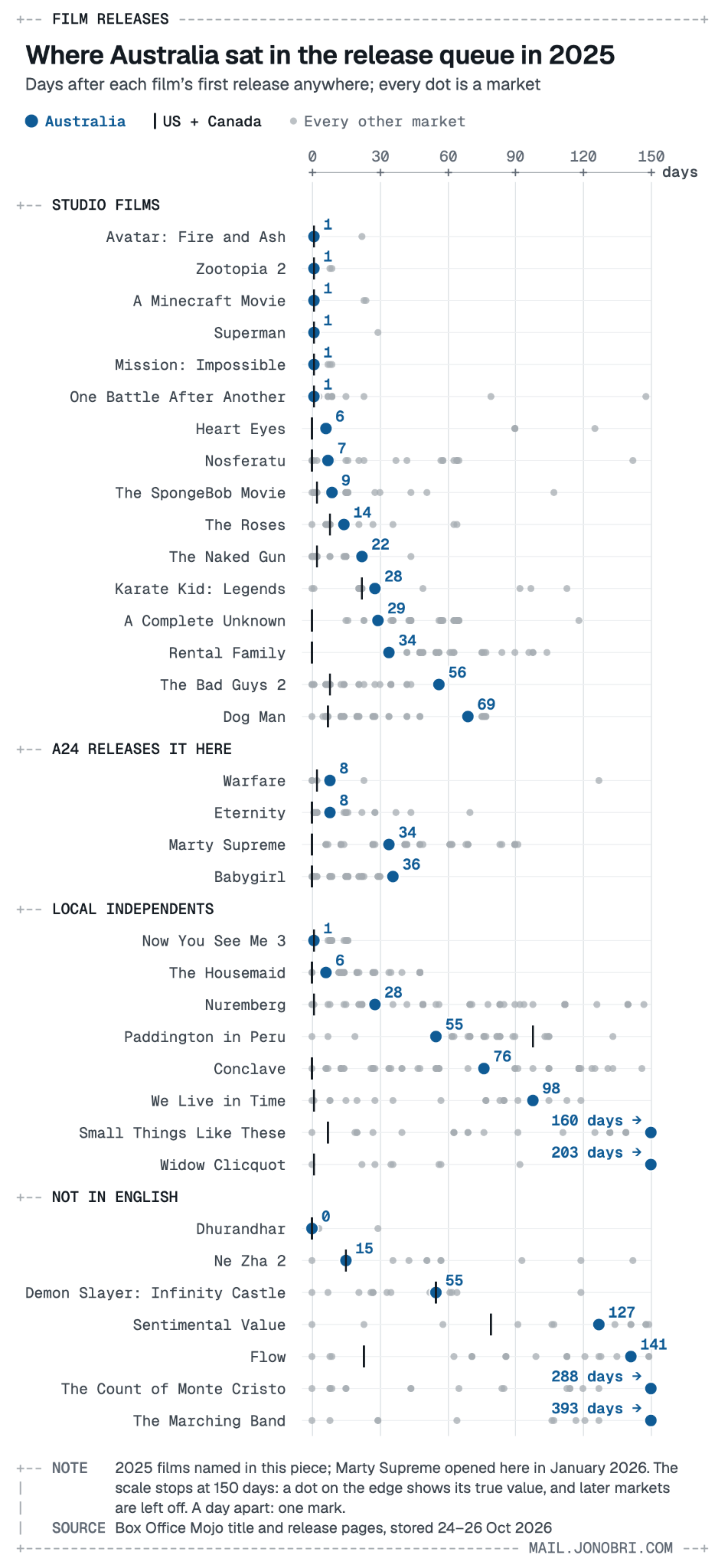
Finally, here is a sample of the top 100 films from 2025, in one chart. Most independents are delivered within two or three months. Foreign films are a bit more random, and in the odd situation they’ll reach Australia before the US.
I’d like to see gaps in film distribution timings close. And given that films released here faster tend to make more money, I imagine most studios and distributors want this too. The fact that it hasn’t happened yet indicates industry-wide constraints, and that those working to bring international films to Australian shores are very likely doing the best that they can.
The important thing to take away from this post is that, generally speaking, you can see everything—just not everywhere, and not all at once.
I also loved Marty Supreme. You mighy like my piece on it: https://kvetch.substack.com/p/marty-supreme?utm_source=share&utm_medium=android&r=22jvd
Regularise ratings agencies, eliminate local distributors, offer directly to cinemas.